

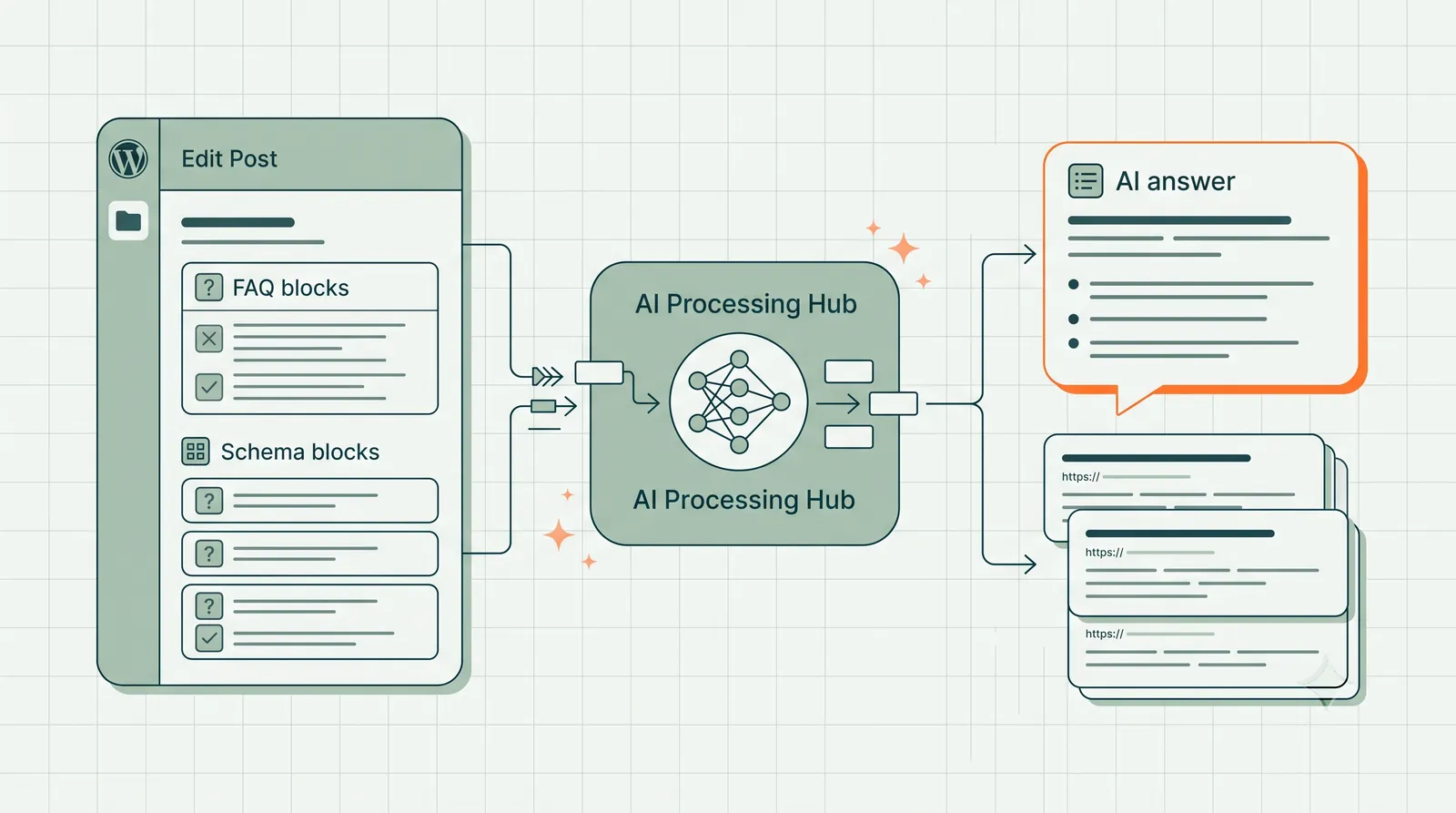
Something shifted in 2025 that most WordPress SEO guides have not caught up with: a growing share of search intent never reaches your site as a click. Users ask ChatGPT, Perplexity, or Google's AI Overviews. An AI synthesizes an answer. Your page might get cited. It might get summarized. It might get ignored entirely while a competitor's passage earns the mention.
That is the problem generative engine optimization (GEO) addresses. Not replacing SEO — extending it. The same WordPress pages that rank on Google can also become sources that generative systems trust and cite. But only if you structure them differently than you did when the goal was exclusively a blue link on page one.
GEO for WordPress is not a separate plugin category or a magic schema toggle. It is a set of content and technical patterns applied to the CMS you already use. Definition-first paragraphs. FAQ blocks with real answers. Valid JSON-LD. Clean heading hierarchy. Passages that stand alone when extracted.
This guide covers what GEO means for WordPress specifically, how it differs from traditional SEO, the patterns that increase citation probability, and how to operationalize GEO without rewriting your entire site.
Last updated: July 11, 2026.
TL;DR
- GEO = optimizing content so generative AI systems (ChatGPT, Perplexity, Google AI Overviews) cite and summarize your pages accurately.
- WordPress sites already have the infrastructure (schema plugins, FAQ blocks, structured headings) — most publishers just do not use it for GEO.
- The highest-impact GEO patterns: direct-answer section intros, FAQ schema, definition blocks, author/expertise signals, and clean extractable passages.
- GEO and traditional SEO overlap heavily — a page optimized for GEO usually ranks better too.
- Automate GEO gaps (missing FAQ schema, thin section intros) with WordPress SEO automation that drafts fixes for approval.
- For the full GEO framework, see Generative Engine Optimization: The Complete Guide.
What GEO means for WordPress (and what it does not)
Generative engine optimization is the practice of making your content legible, trustworthy, and extractable to AI systems that answer questions without sending users to ten blue links.
For WordPress publishers, this matters because:
WordPress content is often long and unstructured. A 2,500-word post with meandering intros is hard for humans and harder for extractors. GEO favors pages where any given section could be quoted in isolation.
WordPress schema support is mature but underused. Rank Math, Yoast, and SEOPress all output JSON-LD. Most sites only enable Article schema and stop. FAQ, HowTo, and Product schema are GEO-relevant and frequently missing.
WordPress sites have authority accumulation. Older domains with consistent publishing history are more likely to be cited than new AI-generated content farms. Your existing library is an asset — if you retrofit it for extractability.
GEO is not:
- Publishing AI slop at scale to "feed the machines"
- Stuffing invisible keywords for LLM crawlers
- Abandoning traditional SEO because "AI is the future"
- A replacement for E-E-A-T and technical fundamentals
It is formatting and substance discipline applied to a platform that makes publishing easy and structured optimization easy to skip.
How generative systems choose what to cite
No one outside Google, OpenAI, and Perplexity has the full citation algorithm. But the observable patterns are consistent enough to act on.
Extractability. Can a 2–3 sentence passage answer a specific question without surrounding context? Generative systems prefer self-contained chunks.
Specificity. Vague thought leadership ("the landscape is evolving") gets ignored. Concrete claims with numbers, steps, or definitions get cited.
Structured markup. FAQ schema, HowTo schema, and clear heading hierarchies help parsers identify Q&A pairs and procedural content.
Source authority. Domain age, topical consistency, HTTPS, author attribution, and external citations signal trust. WordPress sites with focused niches outperform generalist blogs.
Freshness signals. For time-sensitive queries, modified dates and current-year references matter. Stale WordPress posts with 2022 examples get deprioritized.
Consensus alignment. When your claim matches what multiple authoritative sources say, citation probability increases. Contrarian takes can work but need stronger evidence.
The WordPress implication: your block editor structure is your GEO architecture. Headings, lists, FAQ blocks, and pull quotes are not decoration — they are extraction targets.
The WordPress GEO playbook: seven patterns
Pattern 1: Direct-answer section intros
Every H2 section should open with a sentence that answers the question implied by the heading.
Bad H2: "Understanding Email Deliverability" Bad intro: "In today's digital landscape, email remains a critical channel for businesses of all sizes..."
Good H2: "What Is Email Deliverability?" Good intro: "Email deliverability is the rate at which your emails reach recipients' inboxes instead of spam folders. Industry benchmarks range from 85% to 95% for well-maintained lists."
The second version can be extracted verbatim into an AI Overview or Perplexity answer. The first cannot.
Pattern 2: FAQ blocks with schema
Add 5–8 genuine questions per important post. Answer each in 2–4 sentences. Enable FAQ schema through your SEO plugin.
In WordPress with Rank Math: use the FAQ block or add FAQ schema in the Schema tab. In Yoast: use the FAQ block in the block editor.
FAQ content serves dual purpose: long-tail keyword coverage for traditional search and structured Q&A pairs for generative extraction.
Pattern 3: Definition boxes for key terms
For glossary-style terms your audience searches, add a visually distinct definition block:
Striking distance keywords are search queries where your site ranks positions 5–15 with meaningful impressions — close to page one but not there yet.
Blockquotes, callout blocks, or custom Gutenberg patterns work. The format signals "this is a definition" to both readers and parsers.
Pattern 4: Numbered steps for procedural content
HowTo schema applies to tutorials, recipes, setup guides, and any "how do I" content. Structure as:
- Step name (imperative verb)
- One to two sentences of instruction
- Optional screenshot or code block
WordPress tutorial posts that bury steps in prose paragraphs are GEO-invisible. Same content, restructured as numbered steps, becomes citable.
Pattern 5: Comparison tables
"X vs Y" queries are citation magnets for generative systems. A clean HTML table comparing features, pricing, or use cases gives extractors structured data without parsing prose.
In Gutenberg: use the Table block. Keep columns consistent. Include a header row.
Pattern 6: Author and expertise signals
GEO inherits E-E-A-T expectations. WordPress makes this easy to neglect — "Admin" as author on every post.
Fix: real author pages with bios, credentials, and links to other work. Article schema with author Person entity. Updated publish and modified dates visible.
For YMYL topics (health, finance, legal), expertise signals are not optional.
Pattern 7: Internal links as topical reinforcement
Generative systems assess topical authority at the domain level. A WordPress site with 40 posts about email marketing is more citable on email topics than a site with 4 email posts among 200 unrelated articles.
Internal linking reinforces topical clusters. Link related posts with descriptive anchors. GEO and traditional topical authority optimization are the same work.
Technical GEO checklist for WordPress
Run this on your top 20 traffic pages:
- [ ] Valid Article or WebPage schema (test in Google's Rich Results Test)
- [ ] FAQ schema on posts that answer multiple questions
- [ ] HowTo schema on tutorial content
- [ ] Single H1 per page (the post title)
- [ ] Logical H2 → H3 hierarchy without skipped levels
- [ ] Author attribution with linked author page
- [ ] Visible last-updated date
- [ ] Page loads in under 3 seconds on mobile
- [ ] No critical content behind JavaScript tabs that crawlers cannot access
- [ ] Canonical URL set correctly (SEO plugin default)
Most items are configuration, not content rewrites. A Sunday afternoon of schema and author cleanup across your top pages is high-ROI GEO work.
GEO vs SEO: what changes, what stays the same
| Dimension | Traditional SEO | GEO |
|---|---|---|
| Primary goal | Rank in blue links | Get cited in AI answers |
| Unit of optimization | Page | Passage / section |
| Key signals | Backlinks, relevance, CTR | Extractability, specificity, schema |
| Content shape | Comprehensive guides | Comprehensive guides with extractable chunks |
| WordPress tools | SEO plugin + Search Console | Same + schema + FAQ blocks |
The overlap is larger than the difference. You are not maintaining two separate content strategies. You are adding a structural layer to the content you already publish.
Pages that rank well tend to get cited more — because ranking implies authority, and authority implies citation trust. GEO work on pages that already have impressions is the highest-leverage starting point.
Operationalizing GEO on WordPress without a rewrite project
You do not need to retrofit 500 posts this month. Run GEO in three tiers.
Tier 1 (this week): Top 10 pages by Search Console impressions. Add FAQ blocks, rewrite section intros to direct-answer format, validate schema.
Tier 2 (this month): Next 30 pages. Same treatment. Prioritize pages ranking positions 5–15 (striking distance) — they already have visibility and benefit from both GEO and traditional optimization.
Tier 3 (ongoing): New posts ship with GEO patterns baked in. Template: H2 as question, direct-answer intro, FAQ section at bottom, schema enabled.
WordPress SEO automation accelerates Tier 1 and Tier 2 by detecting missing FAQ schema, thin section intros, and schema validation errors — then drafting fixes for your approval. You are not auto-publishing GEO changes blind. You are reviewing diffs with evidence attached.
WordPress plugins and GEO: what helps, what hurts
Rank Math / Yoast FAQ blocks — help when populated with real Q&A. Empty schema containers do nothing.
Table of contents plugins — help extractability by exposing document structure. Ensure TOC links use proper heading IDs.
Page builders (Elementor, Divi) — often hurt GEO by wrapping content in nested divs and shortcodes that parsers struggle with. Prefer native Gutenberg blocks for GEO-critical pages.
Lazy-loaded accordions for FAQs — verify content is in HTML source, not loaded only via JavaScript after click. "View source" test on FAQ sections.
Author box plugins — use for E-E-A-T if they output structured author markup linked to author archive pages.
The plugin stack does not replace content structure. It amplifies or interferes with it.
A 30-day GEO sprint for WordPress publishers
Week 1: Audit top 10 URLs by impressions. Add FAQ blocks. Rewrite H2 intros to direct-answer format.
Week 2: Validate all schema in Rich Results Test. Fix errors. Add HowTo schema to top tutorial post.
Week 3: Author page cleanup. Update modified dates on refreshed posts. Add definition boxes to glossary terms.
Week 4: Internal link pass connecting topical cluster posts. Measure AI Overview citations on target queries.
Repeat quarterly. GEO is maintenance, not a one-time project — same cadence as striking distance optimization. WordPress SEO automation can flag schema and intro gaps weekly so the sprint becomes continuous.
The publishers winning in generative search in 2026 are not the ones who coined "GEO" on Twitter. They are the ones who retrofitted fifty high-impression posts with FAQ blocks and direct-answer intros while competitors kept publishing new thin content. Extraction beats volume.
The WordPress GEO workflow (weekly cadence)
GEO on WordPress is not a one-time rewrite. It is a recurring loop tied to the same Search Console data you already use for traditional SEO. Run it on the same day each week so GEO maintenance does not compete with publishing deadlines.
| Day | WordPress task | GEO output |
|---|---|---|
| Monday | Pull top 20 URLs by impressions from Search Console | Prioritized GEO retrofit queue |
| Tuesday | Open top 3 URLs in block editor | Direct-answer H2 intros rewritten |
| Wednesday | Add or expand FAQ blocks; enable FAQ schema in Rank Math/Yoast | Structured Q&A pairs live in HTML source |
| Thursday | Validate JSON-LD in Rich Results Test; fix errors | Clean schema on retrofitted pages |
| Friday | Internal link pass between cluster posts | Topical authority reinforced for extractors |
Monday (15 minutes). Export or review GSC performance for your highest-impression WordPress URLs. Flag pages ranking positions 5–15 — they already have visibility and benefit from both GEO structure and striking distance optimization.
Tuesday–Wednesday (45–60 minutes). Edit three posts in wp-admin. For each: rewrite section intros to direct-answer format, add a definition box for the primary term, insert a 6-question FAQ block at the bottom. Save as draft if you want a second review pass.
Thursday (20 minutes). Paste each updated URL into Google's Rich Results Test. Fix schema errors before publishing. Common WordPress failures: duplicate FAQ schema from theme + plugin, missing author Person entity, HowTo steps without visible text in HTML.
Friday (15 minutes). Add two to three internal links between related posts in the same topical cluster. GEO inherits domain-level authority signals — clusters that link together get cited together more often than isolated posts.
If manual cadence fails above 30 pages, connect WordPress SEO automation (product hub) to surface missing FAQ schema and thin section intros automatically. You still approve before anything ships. For the full GEO framework beyond WordPress specifics, see the Generative Engine Optimization pillar.
Case study: B2B software blog retrofits 12 posts in 28 days
A 140-post WordPress blog in the project-management niche had strong domain age but flat traffic. AI Overviews were answering "what is resource allocation in project management" without citing their pillar post — even though the post ranked position 7 on Google blue links.
Week 1. The team audited the top 12 URLs by impressions. Every post had Article schema only. Zero FAQ blocks. Section intros started with throat-clearing ("In today's fast-paced business environment...").
Week 2–3. They retrofitted all 12 posts: H2s rewritten as questions, direct-answer first sentences, 6-question FAQ sections with schema enabled, one definition callout per post. Total editing time: 11 hours across two editors.
Week 4. Internal links connected the pillar to eight supporting posts. Modified dates updated. Rich Results Test passed on all 12 URLs.
Results at 60 days. Three posts appeared in AI Overviews for target queries (tracked manually). Referral traffic from perplexity.ai grew from zero to 47 sessions/month — small but directional. Traditional clicks on retrofitted URLs rose 18% aggregate, driven by improved CTR on two striking-distance pages that moved from position 9 to position 5.
The lesson: GEO retrofitting on existing WordPress content beat publishing four new thin posts the same month. Extraction-ready structure on pages Google already trusted compounded faster than volume.
Measuring GEO (imperfect but useful)
Direct "GEO analytics" is immature compared to Search Console. Practical proxies:
AI Overview appearance. Search your target queries in Google. Note whether your domain is cited. Track monthly.
Referral traffic from AI platforms. GA4 may show referrals from perplexity.ai, chat.openai.com, and similar. Volume is still small for most sites but growing.
Impression stability as clicks decline. If impressions hold or grow while CTR drops, AI answers may be intercepting clicks. GEO optimization is the response — not panic about "SEO dying."
Brand search volume. Generative citations increase brand awareness. Brand query growth in Search Console is a lagging GEO indicator.
Do not expect clean attribution yet. Do expect that GEO-structured content performs better on every measurable dimension we can track today.
Frequently asked questions
Is GEO just SEO with a new name?
Partly. The goals overlap. GEO adds passage-level extractability and schema patterns specifically aimed at generative citation. Traditional SEO adds link building and technical crawl optimization that GEO discussions often skip. You need both.
Do I need a separate GEO plugin for WordPress?
No. Your existing SEO plugin (Rank Math, Yoast) handles schema. GEO is primarily a content structuring discipline, not a plugin category.
Will GEO hurt my traditional rankings?
No. Direct-answer intros, FAQ sections, and valid schema are positive ranking signals. GEO patterns align with what Google has rewarded for years — clarity and structure.
Should I block AI crawlers like GPTBot?
Blocking AI crawlers prevents your content from being used in training and may reduce citation probability. Most WordPress publishers should allow crawlers unless they have specific IP/licensing concerns. Check your robots.txt.
How does GEO relate to AI Overviews specifically?
AI Overviews are Google's generative search feature. The same extractability patterns that help Perplexity citations help AI Overview inclusion. Optimize passages, not just pages.
Can GEO be automated on WordPress?
Partially. Schema gaps, missing metas, and thin section detection can be automated. Strategic content additions still need human judgment. Use automation for discovery and drafting, approval for shipping.
Should I rewrite all old WordPress posts for GEO?
No. Start with top 10–30 URLs by impressions. GEO retrofitting follows the same prioritization as striking distance — visibility first, backlog second.
Does block editor vs Classic Editor matter for GEO?
Block editor produces cleaner HTML structure for extractability. Classic Editor and older page builders can work with manual heading discipline. Prefer blocks for GEO-critical content going forward.
How do I train my content team on GEO patterns?
Give writers a template: H2 as question, direct-answer first sentence, FAQ block at bottom, one definition box per post. GEO becomes a formatting habit, not a separate project.
Related reading
- Generative Engine Optimization: The Complete Guide
- How to Rank in AI Overviews
- WordPress SEO Automation
- Striking Distance Keywords for WordPress
- AI SEO Agent for WordPress
RankHive detects GEO gaps on your WordPress pages — missing FAQ schema, weak section intros, schema errors — and drafts fixes for your approval every week. Try RankHive and make your existing content citable.