


The market has decided that "AI SEO" is a category worth selling. What it has not decided is what those two words mean.
Search "AI SEO service" and you will find agencies that use ChatGPT to write blog posts faster. You will find SaaS dashboards that slap an "AI-powered" label on rank tracking. You will find managed services where a human uses AI tools behind the scenes and bills you as if they did it by hand. And you will find a smaller, newer category — AI SEO agents — that actually run the optimization loop autonomously: pull data, find opportunities, draft fixes, and ship them after your approval.
These are not the same product. They are not the same price. They do not produce the same outcome. But the marketing makes them sound identical, because "AI" is doing a lot of heavy lifting in the sales copy.
This essay is the comparison nobody in the AI SEO service market wants you to read. What you are actually buying when you hire an AI SEO service. What you are actually buying when you deploy an AI SEO agent. Where they overlap. Where they diverge. And which one fits your WordPress site.
For the agent side, see AI SEO Agent for WordPress. For the automation layer underneath, see WordPress SEO automation.
Last updated: July 6, 2026.
TL;DR
- An AI SEO service is a human (or team) using AI tools to deliver SEO work — reports, content, recommendations. You pay for their time and judgment.
- An AI SEO agent is software that autonomously runs the SEO loop — data, prioritization, drafting, shipping — with you in the approval seat. You pay for the platform.
- Services scale linearly with cost. Agents scale sub-linearly — more pages, same subscription.
- The service model wins when you need strategy, brand voice, and relationship. The agent model wins when you need recurring execution at scale.
- The best setup in 2026 is often both: agent for execution, human (in-house or agency) for strategy.
Defining the two categories honestly
What is an AI SEO service?
An AI SEO service is a managed offering — from an agency, a freelancer, or a SaaS-with-humans — where AI tools accelerate the work but a human (or team) is doing the SEO.
Typical deliverables:
- Monthly SEO reports with AI-generated commentary
- Content creation (blog posts, product descriptions) drafted by AI, edited by a human
- Keyword research and content briefs produced with AI assistance
- Technical audit reports with AI-prioritized recommendations
- Strategy calls where a human interprets data and sets direction
The AI is a productivity multiplier for the service provider. It is not the service itself. You are paying for human judgment, human relationships, and human accountability — with AI making that human faster.
Price range: $500–$5,000+/month depending on scope, site size, and provider seniority.
What you get: Recommendations, content, reports, and strategy. Usually not shipped on-page fixes unless the service explicitly includes implementation.
Scaling model: Linear. More clients = more humans = more cost. An agency cannot 10x clients without 10x-ing headcount (or dramatically cutting quality).
What is an AI SEO agent?
An AI SEO agent is software that autonomously runs the recurring SEO optimization loop on your site.
Typical capabilities:
- Connects to Google Search Console, Analytics, and your WordPress site
- Continuously analyzes performance data and site state
- Prioritizes opportunities by estimated impact
- Drafts specific on-page fixes (titles, metas, schema, content, internal links)
- Queues drafts for human approval
- Ships approved changes to WordPress via API
- Logs changes and tracks outcomes
The agent is the service. There is no human in the loop unless you put one there (at the approval step). You are paying for continuous execution infrastructure.
Price range: $50–$300/month for most WordPress sites.
What you get: A weekly queue of reviewable, shippable on-page improvements — not reports about what you should do.
Scaling model: Sub-linear. One agent handles one site or fifty sites with the same platform cost. Your bottleneck is approval capacity, not agent capacity.
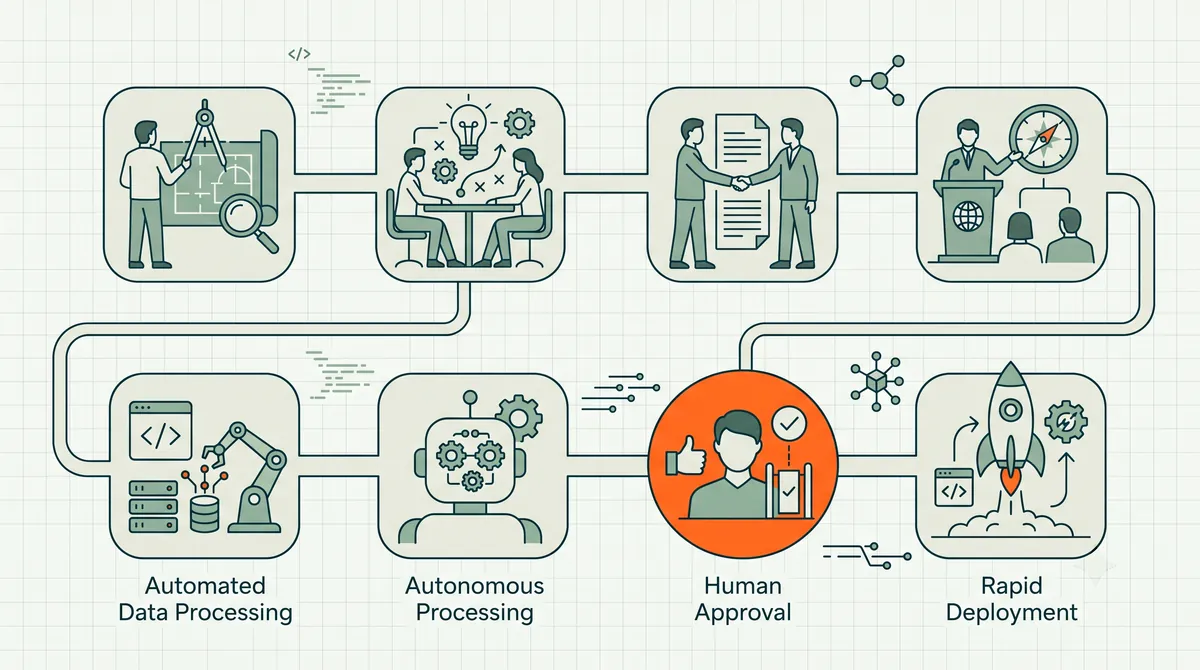
The comparison that matters
| Dimension | AI SEO Service | AI SEO Agent |
|---|---|---|
| Who does the work | Human (AI-assisted) | Software (human-approved) |
| Primary output | Reports, content, recommendations | Shipped on-page fixes |
| Speed of execution | Weekly to monthly cycles | Daily to weekly cycles |
| Cost model | Retainer (scales with scope) | Subscription (scales with sites) |
| Strategy included | Usually yes | No — execution only |
| Brand voice control | High (human writes/edits) | Medium (you approve/edit drafts) |
| Scales with pages | No (more pages = more hours) | Yes (more pages = more opportunities) |
| Ships to WordPress | Sometimes (if included) | Yes (core function) |
| Outcome tracking | Varies by provider | Built into change log |
| Best for | Strategy-heavy, brand-sensitive sites | Execution-heavy, data-rich WordPress sites |
Where the AI SEO service wins
You need someone to think, not just execute. If your SEO challenge is "what should our content strategy be for the next six months," no agent will answer that. You need a strategist. An AI SEO service (or a good freelance SEO) provides the thinking layer.
Your content is brand-critical. Luxury brands, thought leadership sites, and companies where every sentence carries brand weight need human authorship. An agent can draft. It cannot carry your brand voice without significant tuning and oversight.
You want accountability with a face. Some business owners want to call someone when rankings drop. An agent does not pick up the phone. A service does.
Your site is too new for data-driven optimization. Under 500 monthly Search Console clicks, the agent has thin signal. A human SEO can do foundational work — site structure, initial content, technical setup — that does not require performance data.
You need link building. Outreach, digital PR, and relationship-based link acquisition are human work. Agents do not send emails to journalists.
Where the AI SEO agent wins
You have data but no execution bandwidth. 2,000 monthly clicks, 300 pages, and nobody whose job is to check Search Console every week. The agent turns your existing data into shipped fixes.
You need volume, not strategy. Fifty title rewrites, thirty meta updates, twenty schema additions per month. A human service bills 20+ hours for that. An agent produces the drafts in minutes. You approve in an hour.
You are an agency scaling WordPress clients. The agent handles execution across client sites. Your strategists handle relationships and quarterly planning. Unit economics improve because execution does not scale linearly with headcount.
You want outcome traceability. Every change logged. Every outcome measured. No wondering "did the agency actually do anything this month?" The change log is the receipt.
You already have strategy covered. You know your keywords, your content calendar, and your positioning. You just need someone — or something — to execute the recurring on-page work consistently.
The hybrid model (what actually works in 2026)
The false dichotomy is "service OR agent." The productive model is "agent for execution, human for strategy."
Quarterly: Human strategist reviews competitive landscape, sets content priorities, makes IA decisions, plans link-building campaigns.
Weekly: Agent surfaces and drafts on-page opportunities. Human (you, your SEO, or your agency's account manager) approves, edits, and ships.
Monthly: Human reviews agent performance data — what shipped, what moved, what did not — and adjusts priorities.
This hybrid costs less than a full-service agency retainer and produces more shipped changes than either a service or an agent alone. The agent eliminates the execution bottleneck. The human eliminates the strategy vacuum.
AI SEO Agent for WordPress is designed for exactly this split. It does not pretend to replace your strategist. It replaces the 15 hours per month your strategist (or you) spent on title rewrites and meta updates.
How to evaluate what you are being sold
The AI SEO market is full of services rebranded as agents and agents oversold as full-service replacements. Five questions cut through the marketing:
1. "Show me a shipped change on a live site." If the provider cannot demonstrate a specific URL where a specific on-page fix was drafted, approved, and shipped — it is a service, not an agent. Reports do not count.
2. "What happens between the recommendation and the live page?" If the answer involves "your team implements" or "we provide a document," you are buying a service. If the answer involves "you approve and it ships via API," you are buying an agent.
3. "How many changes per month on a site my size?" Services typically deliver 5–15 recommendations per month. Agents typically surface 30–100+ draftable opportunities per month. The volume difference tells you which category you are in.
4. "What is the change log?" Agents have structured change logs: URL, field, before, after, date, approver, outcome. Services have monthly reports. Ask to see the log format.
5. "What happens if I cancel?" With a service, you lose the human. With an agent, you lose the automation but keep every shipped change and its logged outcomes. The agent's value is in the ongoing loop, not in proprietary data lock-in.
Cost comparison (realistic 2026 numbers)
Scenario: WordPress site, 200 pages, 5,000 monthly GSC clicks, needs ongoing on-page optimization.
| Approach | Monthly cost | Changes shipped/month | Strategy included | Outcome tracking |
|---|---|---|---|---|
| DIY (manual) | $0 (your time: ~8 hrs) | 10–20 | No | Manual spreadsheet |
| AI SEO service (agency) | $1,500–$3,000 | 10–20 | Yes | Monthly report |
| AI SEO agent (platform) | $79–$199 | 30–80 | No | Built-in change log |
| Hybrid (agent + quarterly strategist) | $500–$1,000 | 30–80 | Quarterly | Built-in + human review |
The agent is not cheaper because it is worse. It is cheaper because software does not bill by the hour. The trade-off is explicit: you get execution without strategy. If you need both, the hybrid row is the answer.
The migration path: from service to agent without losing momentum
Most site owners do not start with an agent. They start with an agency retainer, realize half the recommendations never ship, and then wonder if the agent replaces the agency entirely.
It does not — not on day one. The migration path that works:
Month 1: Run both in parallel. Keep the agency for strategy and content. Connect the agent for on-page execution. Compare output: how many changes did the agency ship vs. how many did the agent queue?
Month 2: Narrow the agency scope. Move the retainer to quarterly strategy calls and content planning. Move weekly on-page execution to the agent. The agency's value shifts from "we do SEO" to "we set direction."
Month 3: Evaluate. If the agent shipped 3x more on-page changes than the agency did in month 1, the execution layer has migrated successfully. If the agency was providing strategy you still need, keep the quarterly engagement.
Month 4+: Hybrid steady state. Agent runs weekly. Strategist (agency or in-house) runs quarterly. Total cost drops 40–60%. Shipped changes increase 2–3x.
The failure mode is canceling the agency on day one and discovering you have execution but no strategy. The other failure mode is keeping the full agency retainer while also paying for an agent and never giving the agent approval bandwidth. Pick a deliberate migration. Not a rip-and-replace.
The WordPress workflow: service deliverable vs. agent ship
The difference between an AI SEO service and an AI SEO agent becomes obvious when you trace one optimization from signal to live page.
With a typical AI SEO service (agency retainer):
- Agency pulls GSC data during their monthly review.
- They send a PDF: "Page X ranks position 11 for Query Y. Recommend rewriting the title."
- The recommendation sits in your inbox.
- You (or your VA) log into WordPress, find the page, open Rank Math, type the new title.
- Maybe it ships. Maybe it does not. The agency invoices regardless.
With an AI SEO agent on WordPress:
- Agent pulls GSC data every Monday automatically.
- Agent drafts the literal new title and meta, targeting Rank Math's field structure.
- You review the queue — evidence attached: query, impressions, current vs. proposed.
- You click approve. The change ships via REST API in seconds.
- Change log records before, after, date, approver. Agent checks +14 day CTR.
Same starting data. Different terminal state. The service optimizes for the report. The agent optimizes for the shipped fix.
WordPress SEO automation is the execution layer. Your strategist — in-house or agency — still owns quarterly content planning, competitive positioning, and link building. The agent owns the forty title rewrites nobody was going to type.
Mini case study: $2,400/month agency vs. $149/month agent
A WordPress publisher — legal niche blog, 320 posts, 11,000 monthly GSC clicks — paid a "full-service AI SEO agency" $2,400/month for eighteen months. Deliverables: monthly reports, four AI-assisted blog posts, and "ongoing on-page recommendations."
We audited their last six months of agency output. Twenty-three on-page recommendations in reports. Eleven implemented manually (by their editor, not the agency). Zero logged with before/after metrics. Traffic flat.
In April 2026 they kept the agency on a $600/quarter strategy retainer — content calendar, competitive briefs, one call — and connected AI SEO Agent for WordPress at $149/month.
Month 1. Agent queued 67 draftable fixes: 41 title/meta rewrites on striking-distance posts, 14 internal link additions, 8 FAQ schema blocks, 4 thin-content expansions. Editor approved 52 in three weekly sessions (~90 minutes total).
Month 3. 138 on-page changes shipped. Average CTR on rewritten titles up 1.4 points. Six posts moved from position 9–12 to position 4–7. Total SEO spend dropped from $2,400/month to ~$350/month (agent + quarterly strategy).
The agency was not incompetent. They were selling hours in a category that needed loops. Reports do not compound. Shipped fixes do.
What to do this week
- Audit your current SEO spend. Are you paying for reports or for shipped changes? Count the live on-page improvements from the last 90 days.
- Check your Search Console data volume. 500+ monthly clicks means an agent has signal to work with.
- Try the agent model. Connect AI SEO Agent for WordPress, review one weekly queue, and compare the output to your last agency report.
- Keep your strategist if you have one. Fire them only if they were doing execution you can automate — not if they were doing strategy you cannot.
FAQ
Is an AI SEO service just an agency using ChatGPT?
Often, yes. Many "AI SEO services" are traditional agencies that adopted AI writing tools. The deliverable model is the same: human-produced work, AI-accelerated. The price has not dropped proportionally.
Can an AI SEO agent replace my agency entirely?
Only if your agency was doing execution work (title rewrites, meta updates, schema) and not strategy work (content planning, competitive positioning, link building). Most agencies do both. Replace the execution half. Keep the strategy half.
What is the difference between an AI SEO agent and an SEO plugin?
The plugin exposes settings (title fields, schema controls, sitemap config). The agent decides what those settings should be and ships the values. Different layers. See WordPress SEO Plugin vs. SEO Agent.
Do AI SEO services use agents under the hood?
Some are starting to. The question is whether they pass the efficiency savings to you or bill the same retainer while the agent does 80% of the work. Ask directly.
Is an AI SEO agent the same as ChatGPT for SEO?
No. ChatGPT is a general-purpose tool you prompt manually. An agent runs autonomously on a schedule, connected to your data and your WordPress site. Different category entirely.
What about AI SEO content services that publish blog posts?
Content creation services are a third category. They produce net-new content. Agents optimize existing content. Both can coexist. Neither replaces the other.
How do I know if my current provider is a service or an agent?
Ask for the change log. If they show you monthly PDFs with recommendations, it is a service. If they show you a structured log of shipped URL-level changes with before/after values and outcome tracking, they are running agentic tooling — whether they call it that or not. No log means no proof of execution.
Can a small WordPress site afford both?
A site under 500 monthly clicks probably needs a strategist or foundational content work, not an execution agent. A site with 2,000+ clicks and 100+ pages often cannot afford not to automate execution — the manual alternative is your evenings, indefinitely. The hybrid row in the cost table above is the realistic answer for most growing WordPress sites.
Related reading
- AI SEO Agent for WordPress
- WordPress SEO Automation
- SEO AI Agent: What It Is and How It Works
- What Is Agentic SEO?
- Best SEO Automation Tool in 2026
Stop paying for SEO reports. Start shipping SEO fixes. Try RankHive's AI SEO Agent for WordPress — weekly proposal queue, one-click approval, changes live in seconds.