


Imagine an SEO that never sleeps, never forgets to pull Search Console data on Mondays, never gets bored of writing meta descriptions, and never ships a change without asking you first. That is roughly what an AI SEO agent is, and the practice of using one is what people now call agentic SEO.
Agentic SEO is the use of AI agents. Software that can plan, decide, and act on its own. To handle the recurring work that makes up most of modern SEO. Instead of a person running keyword research, technical audits, content briefs, and on-page fixes by hand every week, an AI SEO agent watches your site and your search data, finds the next useful piece of work, drafts the fix, and either ships it or queues it for review.
If you have heard the terms agentic SEO, SEO AI agent, AI SEO agent, AI agent for SEO, or AI agents for SEO in the last year, they all point at the same idea: shift SEO from a calendar of manual tasks to a continuous, agent-driven workflow with a human in the approval seat.
This pillar covers what agentic SEO is, how an AI SEO agent actually works under the hood, the difference between an SEO agent and an SEO tool, real examples of agent-driven workflows, and what it means for solo WordPress owners, in-house teams, and agencies. Read it once. Decide if the pattern fits your site. Skip to the "what to do this week" section if you only have ten minutes.
Last updated: May 29, 2026.
TL;DR
- Agentic SEO is SEO work performed continuously by AI agents that plan, draft, and act on findings rather than just report on them.
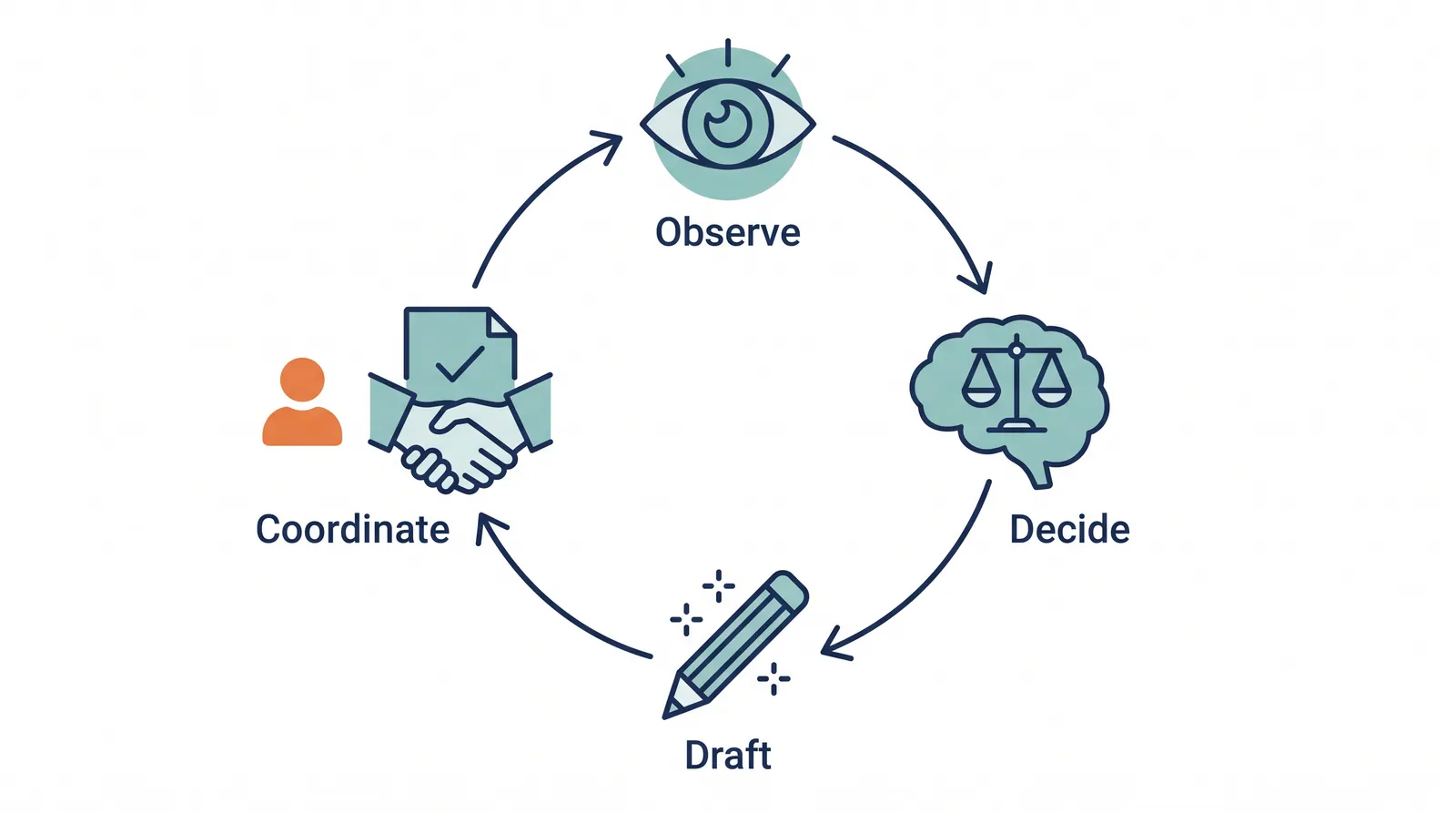
- An AI SEO agent does four things: observe (search data, site state), decide (which fix matters next), draft (the actual change), and coordinate (with the human reviewer and the site).
- Agentic SEO is not autopilot publishing. The good agents wait for human approval before changing live pages.
- The biggest wins today are for WordPress owners and small teams who cannot afford an SEO operator full-time but do need consistent SEO output.
- Tools like RankHive implement this on top of Search Console, Analytics, and the WordPress REST API.
Why a new term. What changed?
SEO has always involved a lot of repeating work. Pulling Search Console exports. Comparing rankings week over week. Looking for content decay. Finding low-CTR titles. Rewriting metas. Fixing broken internal links. Checking page health. Drafting schema markup. Refreshing posts that have slipped.
For 20 years, that work was either done manually by an in-house SEO, outsourced to an agency, or skipped. Which is what happens at most small WordPress sites. The "skipped" bucket is enormous. There are more WordPress sites doing no SEO at all than there are doing it well.
Three things changed between 2023 and 2026 that made the agentic pattern possible.
LLMs got good at SEO drafting. Title rewrites, meta descriptions, FAQ blocks, alt text, and even longer-form content updates are now reliably draftable by a frontier model with a decent brief. The quality is high enough that a human review takes minutes, not hours.
Agent frameworks matured. A model can now hold a multi-step plan, call tools (Search Console API, WordPress REST API, page crawler, keyword data provider), and adapt its plan based on what it sees. The "agent" is not a single chat. It is a small program that keeps state, makes decisions, and acts.
Search data APIs got cheap. DataForSEO, Search Console, and analytics integrations make per-page, per-keyword data accessible to any agent for cents per query. The data plumbing that used to be a project is now an SDK call.
Put together, you can now run the kind of weekly SEO cadence that previously needed a small team. From a single agent loop, with a human in the approval seat. That shift is what the industry started calling agentic SEO.

Agentic SEO vs. traditional SEO automation
Traditional "SEO automation" usually means scheduled reports, scraped rank tracking, and bulk export tools. The work is faster but a human still has to decide what matters, what to write, and where to ship it. The automation is on the information delivery. The actual SEO work stays in the human's lap.
| Capability | Traditional SEO tool | AI SEO agent |
|---|---|---|
| Pulls data on a schedule | Yes | Yes |
| Surfaces ranking changes | Yes | Yes |
| Decides which change matters most | No. Human picks | Yes. Agent prioritizes |
| Drafts the fix (title, meta, content edit) | No | Yes |
| Applies the fix to the site | No | Yes, after approval |
| Tracks outcome and learns from it | Limited | Limited — change log shows what shipped; verify outcomes manually in GSC |
| Loops continuously without prompting | No | Yes |
An SEO tool gives you a dashboard. An SEO agent gives you a queue of reviewable changes. The dashboard is for looking. The queue is for shipping.
How an AI SEO agent actually works
Under the hood, a useful AI SEO agent has four loops. They run constantly, not on a calendar.
1. Observe
The agent pulls live signals from:
- Google Search Console. Queries, impressions, clicks, CTR, position.
- Google Analytics, or whatever analytics you use.
- A crawl of your site. Titles, metas, headings, internal links, schema, page health.
- A keyword data provider. Volume, KD, related terms, SERP makeup.
- The site's CMS state. Drafts, scheduled posts, recent publishes.
This data joins together into a single picture of your site. The agent reads it the same way an experienced SEO would: looking for patterns that match known opportunities.
2. Decide
The agent compares what it sees against a set of patterns it cares about: keyword gaps, striking-distance pages (positions 5 to 15), declining pages, low-CTR titles, broken internal links, missing schema, thin pages on high-intent keywords, content decay on old posts.
It scores those findings. Usually by traffic impact × effort to fix. And picks the next piece of work. A good agent does not surface 200 issues. It surfaces five. The right five.
3. Draft
For each piece of work, the agent produces a concrete, reviewable artifact:
- A new title and meta description with an explanation of why.
- A content update with the diff highlighted.
- A schema markup block.
- A redirect or canonical change.
- A new internal link suggestion with anchor text and source page.
A good agent always shows the why. The evidence (Search Console data, the SERP comparison, the gap analysis) sits next to the draft. If the human cannot see why the change is being proposed, the human will not trust the change. Trust is the only thing that keeps the approval queue moving.
4. Coordinate
This is the part most "automated SEO" tools skip. The agent does not silently push edits. It:
- Queues the draft for human review.
- Sends a notification.
- Records the approval (or rejection).
- Pushes to the site only after approval.
- Logs the change to a history view with a before/after content diff and a rollback link.
This loop is what separates a useful agent from a content firehose. Skip the coordination layer and you have a publishing bot. Add it and you have an agent.
AI SEO agent vs. AI SEO tool. Which do I want?
People search for both AI SEO tool and AI SEO agent because the line is fuzzy. A useful rule of thumb:
- An AI SEO tool uses AI inside a feature. An AI title generator. An AI meta description generator. An AI content optimizer. You still drive the workflow. The tool helps with one step.
- An AI SEO agent drives the workflow itself. It picks what to work on. It drafts the change. It routes the draft for approval. You drive the approvals, not the queue.
If your SEO problem is "I have 30 minutes a week and I need consistent output," you want an agent. If your problem is "I am a skilled SEO and I want a faster brief generator," a tool is enough. Most teams need some of both. The agent runs the recurring loop. The tools speed up the parts the agent does not touch.
For a tested comparison of both categories side by side, see Best AI SEO Tools in 2026.
Where agentic SEO works well today
The strongest fit in 2026 is WordPress site owners and small-team marketers who:
- Have real Search Console data. A site that gets at least a few hundred clicks a month.
- Run on WordPress so the agent can push approved changes via the REST API.
- Cannot justify a full-time SEO hire but do need a weekly cadence.
- Want to stay in the approval seat (no surprise edits).
For this audience, an SEO agent collapses a 6-hour weekly cycle (export → analyze → write → publish → log) into a 30-minute review session. The agent does the boring parts. You do the deciding parts.
Agentic SEO is also working well for:
- Agencies managing many small sites. Each site gets its own agent loop. The human team reviews.
- SaaS marketing teams that want to keep docs, blog posts, and landing pages tuned without dedicated SEO headcount.
- E-commerce sites with thousands of product or category pages where per-page manual SEO is impossible.
It is not a great fit (yet) for:
- Brand-new sites with no Search Console data. The agent has nothing to observe.
- Highly regulated industries where every word must pass legal or compliance review. The approval loop becomes the bottleneck.
- Custom CMSes without a clean publishing API. The agent cannot ship.
What "agentic" should not mean: no surprise edits
The phrase "AI agent" makes some people nervous, and reasonably so. Nobody wants to wake up to a tool that rewrote their pricing page overnight. The 2023 to 2024 wave of "AI publishes for you" tools earned this skepticism the hard way. By publishing things people did not approve.
A well-designed agentic SEO system holds two principles tight.
Every change is reviewable. The agent shows the proposed change, the page it affects, the evidence, and the expected impact. before it touches the site. If you cannot see what would change, you do not have an agent. You have a black box.
The human approves. Approval is per change. You can approve, edit, deny, or queue. You can roll back. You can pause the whole loop. The agent is opinionated. The human is in charge.
This is exactly how RankHive works. It is SEO autopilot for WordPress, but autopilot does not mean surprise edits. Every proposal goes through your review queue first. The autopilot is on the work before approval. It is not on the work after approval.
What an agentic SEO workflow looks like in practice
A typical week with an SEO agent in place:
- Monday. Agent pulls Search Console data. Finds a striking-distance keyword on an old post (position 8, decent CTR, decaying impressions). Drafts an updated H2, three new internal links, and a refreshed meta description. Queues for review.
- Tuesday. You review three queued proposals in about 10 minutes. Approve two. Edit one. Deny none.
- Wednesday. Agent pushes the approved changes to WordPress. Logs them to the history with a before/after diff and a rollback link.
- Thursday. Agent surfaces a technical issue: 14 product images on the highest-traffic posts are missing alt text. Drafts alt text for each. Queues.
- Friday. You batch-approve the alt-text fixes. Take a look at the change history. Move on.
That cadence is what gets skipped at most small sites. Not because it is hard. Because it is too boring to do by hand every week. The agent removes the willpower problem.
The compounding from running this cadence every week is real and not flashy. On a typical 100-page WordPress site, an agent will surface 8 to 15 proposals per week. About 60 to 70% get approved. Most are small. A title rewrite, a missing meta, a fresh internal link. Over a quarter, that adds up to 80 to 120 shipped changes. Over a year, it changes the trajectory of the site.
A worked example: 30 days of agentic SEO
A real WordPress site I helped onboard last winter. A small B2B blog with 62 indexed pages. Ran the agent for 30 days. Here is what it surfaced and what shipped.
Week 1. The agent flagged six pages with missing meta descriptions and two with truncated titles. It also caught a broken canonical on a category page that was sending bot traffic into a loop. All eight changes shipped after approval. Time to review: about 25 minutes total across the week.
Week 2. The agent surfaced a keyword cluster the site was almost covering but not quite. Three queries getting impressions with no clicks, and no clear page to land them. It drafted an outline for a new post and queued the outline for approval. The owner edited the outline, approved it, and assigned it to a writer.
Week 3. Two striking-distance pages got title and intro rewrites. CTR on one of them moved from 1.4% to 3.1% within the following two weeks.
Week 4. The agent ran an alt-text pass across the top 20 highest-traffic posts. 47 alt-text additions shipped in a single batch approval.
By day 30, the site had shipped 71 SEO changes. The owner's total time spent: about three hours across the month. The equivalent manual workload would have been roughly six hours per week. 24 hours for the month.

Common questions
Is agentic SEO the same as GEO or AEO?
No. GEO and AEO describe optimizing for AI-generated search results. Agentic SEO describes using AI to do the optimization work. You can do all three at once. They are different layers.
Will an AI SEO agent replace SEO consultants?
Not the strategic work. Agents are great at the recurring, pattern-matching tier of SEO. They are still weak at brand voice judgment calls, executive strategy, large information-architecture overhauls, and link-building outreach. Consultants who lean into the strategic tier. And let the agent handle the recurring tier. Are doing better than ever.
Do I need to know prompts to use an SEO agent?
No. The whole point is that the agent is opinionated. You connect your site and your data. It picks the work. You can tune the prompts under the hood if you want, but the default flow does not require it.
What about content quality and AI penalties?
Google has been clear that the issue is unhelpful content, not the production method. An agentic workflow that drafts focused, evidence-backed updates and ships them after human review is qualitatively different from spinning up 10,000 thin AI articles. The first reliably ranks. The second reliably does not.
How is this different from "ChatGPT for SEO"?
ChatGPT is a tool you use. An agent is a process that runs on your site. ChatGPT will not pull your Search Console data, schedule a weekly review, ship to WordPress, and log outcomes. An agent will. The two complement each other. You can still ask ChatGPT for a one-off rewrite while the agent runs the weekly loop.
Can I run an agent on top of an existing SEO plugin?
Yes. An SEO plugin handles WordPress-level controls. Titles, metas, sitemaps, schema. An agent decides what those controls should say. They live at different layers. RankHive, for example, runs cleanly next to Yoast, Rank Math, or SEOPress without overlap.
How do I know if the agent is working?
You measure. Tag every shipped change with date and URL. Pull the +14 day and +30 day outcome metrics. The honest answer for any tool. Agent or otherwise. Is in the deltas, not in the dashboard graphs.
When agentic SEO is the wrong choice
Three honest scenarios where you should not buy an agent yet.
Your site is too new. With under a couple hundred clicks a month from Search Console, the agent has no signal to work with. It will surface generic suggestions. Spend the first six months writing the first wave of content. Add the agent when there is data to chew on.
Your content is highly regulated. Legal, financial, medical, or compliance-bound content needs human review at the draft stage, not just at the approval stage. The agent can still help with technical SEO and metadata. The content body should not be drafted by AI without a domain expert in the loop.
You have a dedicated SEO who loves the loop. If someone on your team enjoys the weekly cadence and is producing strong output, the agent will feel like a downgrade in their authorship. Use AI tools to speed up that person's work. Skip the agent.
What to do this week
- Connect Google Search Console and Analytics to whatever tool you choose.
- Pick five striking-distance pages (positions 5 to 15) and let an agent. Or you, manually. Draft a title, meta, and internal-link update for each.
- Ship the updates and track CTR and position over the next 30 days.
- Decide whether to formalize the loop with an agent like RankHive or keep doing it by hand.
If you formalize the loop, the leverage compounds. If you do not, the work tends to slip. The agent's job is to keep the loop alive while you stay in the decision seat.
Agentic SEO versus traditional managed SEO
A useful comparison for anyone deciding between hiring an SEO agency, hiring in-house, or running an agent.
Cost. Agency SEO retainers in 2026 typically start at $1,500 per month for a small business and climb steeply. An in-house SEO is $80k+ per year fully loaded. An agentic platform for a single small site is usually under $100 per month. The cost gap is not subtle.
Speed. An agency cycle is usually monthly. They report once a month, recommend changes, and ship slowly. An in-house SEO can ship weekly. An agentic platform surfaces and drafts changes daily. The speed delta compounds.
Coverage. An agency or in-house SEO has good judgment but limited bandwidth. They handle five to twenty changes a month. An agent handles fifty or more. Bounded by your approval capacity, not by their throughput.
Strategy. This is the one area an agent does not match a senior human. Strategic positioning, brand voice, link strategy, complex IA decisions. These still benefit from a human strategist. The right model in 2026 is often agent for execution, human for strategy. Not one or the other.
Failure modes. Agencies sometimes coast. In-house SEOs sometimes leave. Agents do not coast and do not leave. They also do not invent new strategies on their own.
The honest framing: a serious site benefits from both layers. The agent runs the recurring work. A human (in-house, agency, or contractor) handles the strategic work. Picking one to the exclusion of the other usually leaves output on the table.
On WordPress specifically, the agent loop looks different from generic CMS advice — plugin stack, REST writes, and approval gates matter. See Agentic SEO for WordPress for the site-specific version of this pillar.
The next 18 months in agentic SEO
The category is still young. Three things I expect to change between now and the end of 2027 based on the direction of the tooling and the search platforms.
Coverage will expand past WordPress. Today the cleanest agentic SEO pipelines exist on WordPress because the REST API is mature. Shopify, Webflow, Ghost, and major headless CMS platforms will catch up. The agent pattern is not WordPress-specific. The publishing path is.
Agents will get better at multi-step reasoning across surfaces. Today's agents are strong on bounded tasks (rewrite this title, draft this schema). The next wave will reason across surfaces. Connecting a Search Console position drop to a competitor publication to a content refresh recommendation in a single chain.
The line between "SEO agent" and "marketing agent" will blur. Email, social, and product analytics share inputs with SEO. The first vendor to ship a credible cross-channel marketing agent will collapse several categories into one. That is a one-to-two-year horizon, not five years.
Plan for these shifts but do not wait for them. The agent pattern that works today is good enough to compound for two years before the next wave matters. The teams that adopt now will be the ones the wave catches up to, not the ones racing to catch up to it.
Related reading
- What Is SEO for AI Called? GEO, AEO, and Agentic SEO
- Best AI SEO Tools in 2026 (Tested and Ranked)
- The Complete Guide to AI for SEO (2026)
- How to Automate SEO: The Complete Playbook
- SEO Automation Software: The Definitive Comparison
- AI SEO Optimization: Tools and Techniques
Want to see an AI SEO agent at work on a real WordPress site? Try RankHive: SEO autopilot for WordPress. It runs the four loops above continuously and waits for your approval before anything goes live.