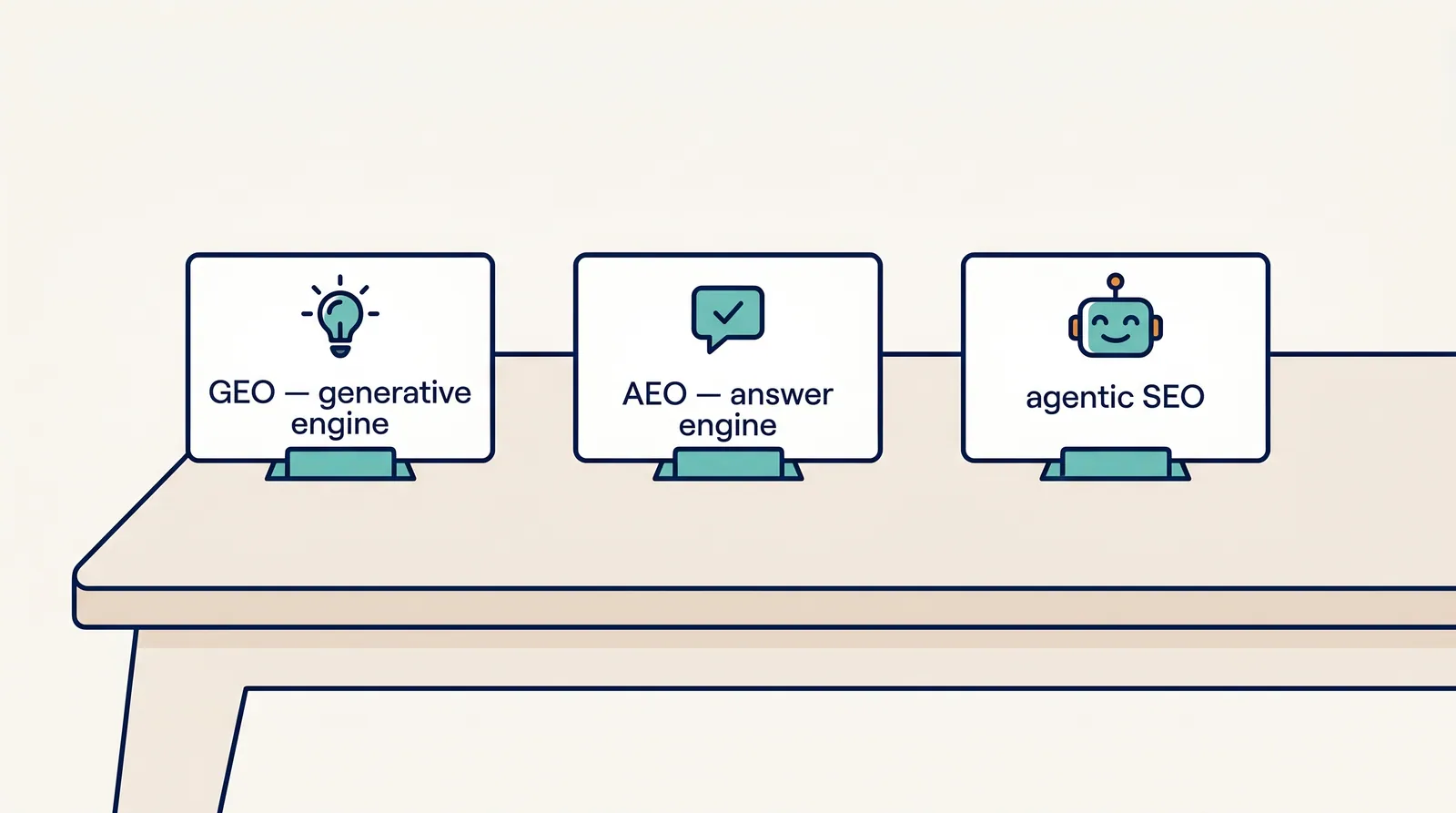
If you have spent any time researching how to rank in ChatGPT, Google AI Overviews, Perplexity, or other generative search experiences, you have probably noticed something confusing. There is no single agreed-upon name for the practice. Some people call it LLM SEO. Some call it GEO. Some call it AEO. And a few stubborn holdouts insist on calling it "just SEO."
So what is SEO for AI called, which term should you actually use, and what do you do differently?
The short answer is that the terms overlap, but they are not identical. LLM SEO, GEO and AEO each describe a slightly different slice of the same shift: search results are being generated, summarized, and answered by AI systems instead of returned as a list of ten blue links. A fourth term, agentic SEO, gets mixed in with them but means something else entirely. This post is a plain-English breakdown of each term and which one to focus on first, followed by a practical playbook for doing the work on a WordPress site: the content patterns, the technical checklist, the plugins that help and hurt, and a way to roll it out without a rewrite project.
Last updated: October 13, 2026.
TL;DR
- LLM SEO. Optimizing so large language models (ChatGPT, Claude, Gemini, Perplexity, Copilot) can find, understand and cite your pages. In practice the same work as GEO, named after the models rather than the search engines.
- GEO (Generative Engine Optimization). The broadest established term. Optimizing content so it gets surfaced and cited by generative search engines, Google AI Overviews included.
- AEO (Answer Engine Optimization). Narrower. Optimizing content to be picked as the direct answer in answer-first interfaces. AI Overviews, voice assistants, featured snippets.
- Agentic SEO. Not a target at all. It is using AI agents to run the recurring SEO work. Research, audits, fixes. Less about how AI consumes your content. More about how AI helps you produce it.
- On WordPress, the work is mostly structure. Answer-first section intros, real FAQ blocks, definition boxes, numbered steps, comparison tables, author pages, valid schema, and letting AI search crawlers in. The playbook is below.
In short: LLM SEO, GEO and AEO describe the target (be cited in AI search). Agentic SEO describes the method (use AI agents to do the work). You can do all of them at once.
What is GEO (Generative Engine Optimization)?
GEO stands for Generative Engine Optimization. The term started showing up in industry conversation in late 2023 and picked up speed through 2024 and 2025 as Google AI Overviews rolled out globally and ChatGPT-style search became a daily habit for tens of millions of users.
GEO is the discipline of making sure your content gets pulled into AI-generated answers. Not just shown as a blue link in a SERP, but actually quoted, summarized, or cited inside the AI response itself.
What changes versus traditional SEO.
- Citations matter more than rankings. In a generative answer, you do not have a "position 4." You either get cited or you do not.
- Passage-level relevance matters more than page-level. AI systems pull paragraphs, lists, and tables. Not whole pages.
- Structured, scannable content wins. Tables, definition lists, FAQ blocks, clear H2s, and explicit answers in the first sentence of each section are all more likely to be lifted into a generated response.
- Brand mentions and entity recognition matter. AI models are more likely to cite sources they already "know". Sites with consistent name and brand entities across the web.
- Freshness signals count. Models lean toward sources with recent "last updated" stamps when the topic is time-sensitive.
A practical GEO checklist: clear definitions in the first paragraph of each section, schema markup, comparison tables, original first-party data, expert quotes, and unambiguous statements of fact that an LLM can lift verbatim without misrepresenting you. The rule of thumb is, if the answer to the section's headline question is not in the first 50 words, the AI will probably skip you. Our generative engine optimization guide goes deeper on how retrieval picks passages and how GEO differs by content type.
What is AEO (Answer Engine Optimization)?
AEO stands for Answer Engine Optimization. It is older than GEO. It grew out of voice search and featured-snippet optimization work in 2017 to 2019. But it has been re-energized by the rise of AI-first search interfaces.
AEO focuses specifically on the answer slot. The goal is to be the one source picked by the answer engine when a user asks a direct question. Where GEO is broad ("get cited anywhere in the generative response"), AEO is sharp ("be the answer").
Where AEO matters in 2026.
- Google's AI Overviews. The answer slot at the top of the SERP.
- Bing Chat and Copilot. The default answer interface inside the Microsoft stack.
- Siri, Alexa, Google Assistant. Voice still uses the answer-slot pattern.
- Perplexity's direct answer card. The opinionated answer at the top of every Perplexity query.
- ChatGPT search's primary citation. The one source ChatGPT leans on hardest in its summary.
The AEO playbook is older and tighter than the GEO one.
- Use a clear question as an H2 or H3 ("What is X?").
- Put the answer in the very next sentence. Under 50 words. Plain prose.
- Follow up with deeper context. Make sure the answer itself can stand alone.
- Mark up genuine FAQ content with FAQPage schema.
- Avoid burying the answer under setup, anecdotes, or a paywall.
If GEO is the strategy, AEO is one specific tactic inside it. You do AEO to win the answer slot. You do GEO to make sure you show up in the broader generative response even when you do not win the slot. For Google's answer slot specifically, see how to rank in AI Overviews.
What is LLM SEO?
LLM SEO (sometimes LLMO, for LLM optimization) is the name you will hear from people who think about the models rather than the search engines: making your content easy for large language models to retrieve, understand and cite. It covers ChatGPT search, Claude, Gemini, Perplexity and Copilot as well as Google's own AI features.
In practice LLM SEO and GEO describe the same work, and the content advice is identical. The LLM framing is useful because it keeps two technical facts in view that content advice tends to skip:
- Retrieval comes before citation. When an assistant answers from the live web, it first fetches candidate pages through a search index and its own crawler. If your robots.txt, firewall or CDN blocks that crawler, no amount of good writing gets you cited. How to rank in ChatGPT walks through that pipeline for ChatGPT.
- Training and search are separate questions. Most AI companies run one crawler to collect training data and another to fetch pages for live answers. Blocking the training crawler does not remove you from answers; blocking the search crawler does. The robots.txt section below lists the main ones.
What is agentic SEO?
Agentic SEO is the newest term of the four. It describes something different from LLM SEO, GEO and AEO. Agentic SEO is not about how AI consumes your content. It is about how AI helps you produce and maintain it.
The core idea: instead of an SEO team running keyword research, audits, content briefs, technical checks, and content refreshes by hand every week, you delegate the recurring work to AI agents. The agents watch your site, watch your search data, find the next useful piece of work, and either draft it or do it. The human stays in the approval seat.
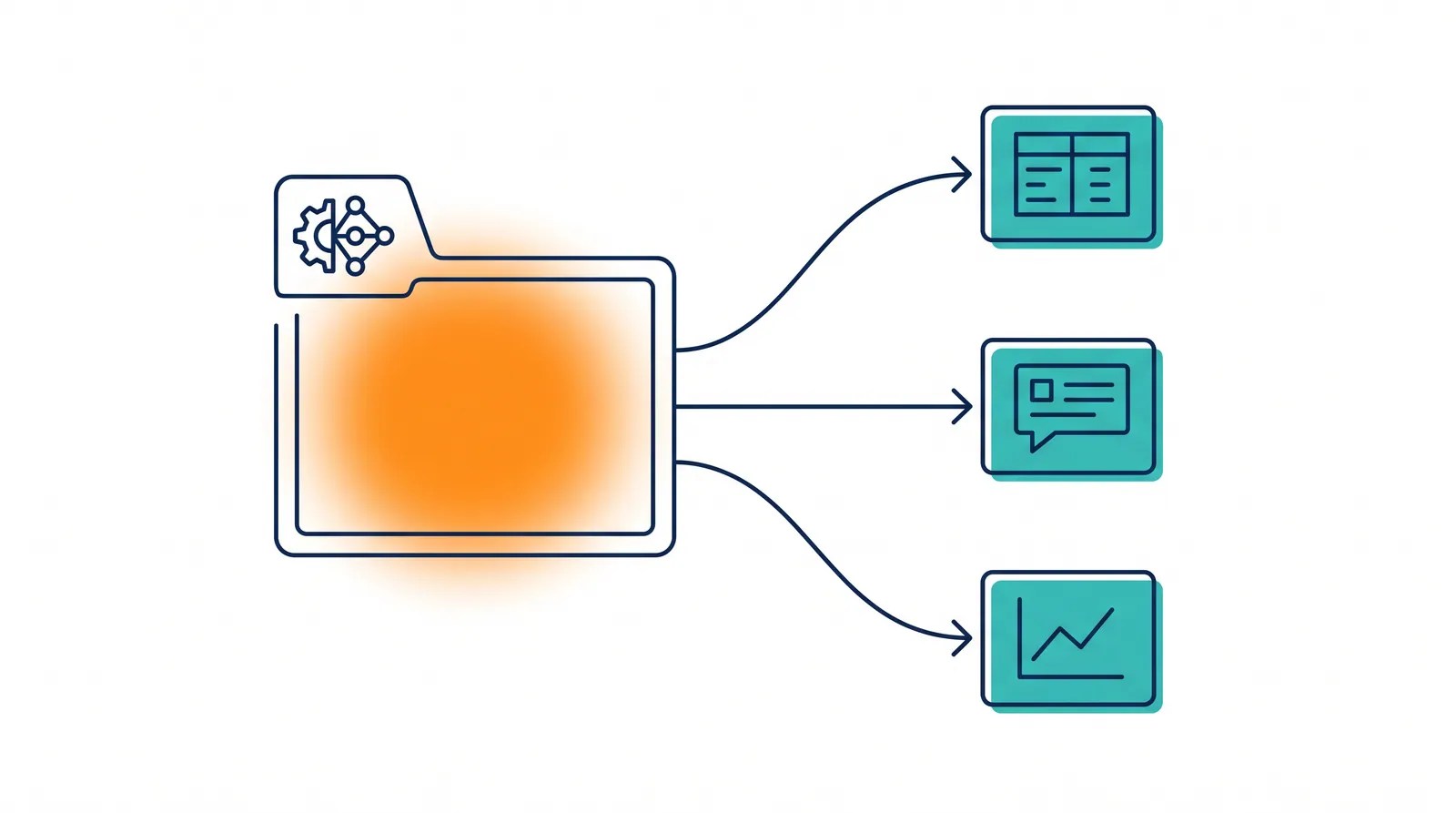
This is what RankHive does for WordPress sites. Every week it reads your Search Console data, finds the pages sitting just off page one and the technical issues Google reports, and drafts the fix, such as a new title, a meta description, an internal link or a schema block. Nothing goes live until you approve it, and every change is logged so you can revert it. How RankHive works walks through each step.
Agentic SEO usually includes.
- Automatic keyword gap analysis from Search Console plus analytics data. (RankHive reads Search Console only, not analytics.)
- Continuous technical SEO checks. Indexability, page health, internal linking, image issues, schema validity.
- AI-drafted titles, meta descriptions, schema markup, alt text, and content updates.
- A review-and-approve workflow so the human stays in control.
- Change history so you can see what shifted and roll back if needed.
- Outcome tracking so the loop closes. Every change has a CTR and impressions check 14 and 30 days later. (RankHive logs every change; that check is yours, in Search Console.)
For the full explanation, see what an AI SEO agent is. It walks through the loop a real agent runs (read, prioritise, draft, gate, ship, measure) and how to tell it apart from a chat window on a dashboard.

Are LLM SEO, GEO, and AEO different from "just SEO"?
Yes and no.
Traditional SEO already cares about structure, schema, intent, and authority. LLM SEO, GEO and AEO inherit most of those fundamentals. If your on-page basics are weak, no clever GEO tactic will save you. The Google update history has been pretty clear on this. There is no shortcut around fundamentals.
What is genuinely new in 2026.
The destination has changed. You are no longer optimizing only for a ranked list. You are optimizing to be selected and cited by a generative system. Sometimes both. Sometimes only one. They can come apart in surprising ways. Pages that rank well in blue links sometimes get skipped in AI Overviews, and vice versa.
The signals have changed. Entity consistency, brand recognition by LLMs, citation patterns, and passage-level structure carry more weight than they did five years ago. The same page in two formats. One a wall of prose, one a structured set of H2s with direct answers. Will perform differently in AI surfaces even though they say the same thing.
The tooling has changed. Agentic SEO tools mean a single WordPress owner can now run the kind of weekly SEO cadence that previously needed a small agency. The ceiling on what one person can produce is higher than it was three years ago.
So these are not "SEO 2.0." They are SEO with a different target surface and faster tooling.
Which term should I actually use?
Pragmatic answer.
- If you are writing about how content shows up in AI-generated search results, use GEO for the broad case and AEO for the specific answer-slot case. LLM SEO is the same idea, and the term you will hear most from people working on ChatGPT and other assistants.
- If you are writing about using AI to do SEO work, use agentic SEO.
- If you are talking to clients or non-specialists, "SEO for AI search" or "AI SEO" is fine. Most people search for it that way. That is literally why this article exists.
You will see practitioners use the terms differently. Do not get too hung up on which label is "correct." The underlying work. Clear structure, accurate content, strong entities, fast site, useful fixes shipped consistently. Is what actually moves the needle.
A side-by-side comparison
| Term | What it optimizes for | Where it lives | First action to take |
|---|---|---|---|
| GEO | Citation inside generative answers | Output side (your content) | Rewrite intros and add direct answers |
| LLM SEO | Being retrieved and cited by AI assistants | Output side (content and crawl access) | Check AI search crawlers are allowed, then rewrite intros |
| AEO | Winning the answer slot | Output side (your content) | Use Q-as-H2 + 50-word answer + FAQ schema |
| Agentic SEO | The work of producing and maintaining content | Workflow side (your process) | Add an agent to your weekly SEO loop |
The clearest way to think about it: LLM SEO, GEO and AEO change what you publish. Agentic SEO changes how you produce it. The combination is where most of the leverage sits in 2026.
How to do SEO for AI on a WordPress site
Whatever you call it, on WordPress the work comes down to a set of content and technical patterns applied to the CMS you already use. It matters on WordPress for three reasons:
- WordPress content is often long and unstructured. A 2,500-word post with a meandering intro is hard for humans and harder for extractors. AI systems favor pages where any given section could be quoted in isolation.
- WordPress schema support is mature but underused. Yoast, Rank Math and SEOPress all output JSON-LD. Most sites leave Article schema on and stop there.
- An established library is an asset. Older, focused sites with consistent publishing history are more likely to be cited than new content farms, if you retrofit the existing pages so they can be extracted.
It is not publishing AI content at scale to "feed the machines", hiding keywords for LLM crawlers, installing a "GEO plugin", or abandoning traditional SEO. It is formatting and substance discipline on a platform that makes structure easy to skip.
Seven content patterns
1. Direct-answer section intros. Every H2 section should open with a sentence that answers the question its heading implies. "Understanding Email Deliverability" followed by "In today's digital landscape, email remains a critical channel..." gives an extractor nothing. "What Is Email Deliverability?" followed by "Email deliverability is the share of your emails that reach the inbox instead of the spam folder" can be lifted verbatim.
2. FAQ blocks with real answers. Add five to eight questions people actually ask to your important posts, each answered in two to four sentences, using the FAQ block in Yoast or Rank Math so the markup is generated for you. Google limited FAQ rich results to well-known government and health sites in 2023 and stopped showing them for every site on May 7, 2026, so do this for readers and extractors, not for a rich result.
3. Definition boxes for key terms. For terms your audience searches, add a visually distinct definition near the top, in a quote, callout or reusable block pattern:
Striking distance keywords are search queries where your site ranks around positions 5–15 with meaningful impressions — close to page one but not there yet.
4. Numbered steps for procedural content. Tutorials buried in prose paragraphs are hard to extract. Put the steps in a List block: an imperative step name, one or two sentences of instruction, an optional screenshot. Google retired HowTo rich results in 2023, so HowTo markup is optional; the numbered structure is what matters.
5. Comparison tables. "X vs Y" queries are natural citation targets. A Table block with a header row and consistent columns gives an extractor structured data without parsing prose.
6. Author and expertise signals. "Admin" as the author on every post is a common WordPress default. Give each author a real author page with a bio and credentials, make sure the Article schema names them as a Person, and show the updated date. For health, finance and legal topics this is not optional.
7. Internal links as topical reinforcement. A site with 40 posts about email marketing is a more credible source on email than one with four among 200 unrelated articles. Link related posts to each other with descriptive anchors; it is the same work as building topical authority for traditional search.
Technical checklist for WordPress
Run this on your top 20 pages by impressions:
- [ ] Valid Article or WebPage schema, checked in Google's Rich Results Test (Article) or the Schema Markup Validator (WebPage, which the Rich Results Test doesn't report)
- [ ] FAQPage markup only on posts with a visible, genuine FAQ, and not output twice by your theme and your SEO plugin
- [ ] A single H1 per page (the post title)
- [ ] A logical H2 → H3 hierarchy without skipped levels
- [ ] Author attribution with a linked author page
- [ ] A visible last-updated date
- [ ] Core content in the HTML source, not loaded only after a click on a tab or accordion
- [ ] A correct canonical URL (your SEO plugin's default is usually right)
- [ ] AI search crawlers not blocked by robots.txt, a security plugin or your CDN's bot settings
Most items are configuration, not rewrites.
Let AI search crawlers in
Check your robots.txt (and any bot-blocking setting in a security plugin or CDN) against the crawlers that fetch pages for live answers:
- Googlebot fetches pages for Google Search, AI Overviews and AI Mode included. Google-Extended only controls whether Google may use your content to train Gemini models and to ground answers in Gemini Apps and Vertex AI; blocking it does not remove you from AI Overviews.
- OAI-SearchBot fetches pages for ChatGPT search. Block it and you will not be cited there. GPTBot collects training data, and blocking it has no effect on ChatGPT search.
- PerplexityBot indexes pages for Perplexity's answers.
- Bingbot matters too: Copilot answers from Bing's index, so submit your sitemap in Bing Webmaster Tools as well as Search Console.
Whether to allow the training crawlers is a business decision about your content, not an SEO requirement. Most WordPress publishers who want AI citations should at least allow the search crawlers.
WordPress plugins: what helps, what hurts
- Yoast and Rank Math FAQ blocks help when they hold real questions and answers. Empty schema containers do nothing.
- Table of contents plugins help by exposing the page structure, as long as their links use the headings' real IDs.
- Page builders such as Elementor or Divi can bury content in nested markup and shortcodes. Prefer native blocks on the pages you most want cited.
- Lazy-loaded accordions for FAQs: open "view source" and confirm the answers are in the HTML, not fetched by JavaScript after a click.
- Author box plugins help if they output structured author markup linked to the author archive.
The plugin stack does not replace content structure. It amplifies it or gets in its way.
Roll it out without a rewrite project
You do not need to retrofit 500 posts this month. Work in three tiers:
- This week: your top 10 pages by Search Console impressions. Rewrite section intros to answer first, add an FAQ block, validate the schema.
- This month: the next 30, starting with pages at positions 5–15. They already have visibility and benefit from GEO structure and striking-distance fixes at the same time.
- From now on: every new post ships with the patterns built in. Give writers a template: H2s as questions, an answer-first opening sentence, one definition box, an FAQ at the bottom.
A weekly cadence keeps it from competing with publishing:
| Day | WordPress task | Result |
|---|---|---|
| Monday | Pull the top 20 URLs by impressions from Search Console | A prioritized retrofit queue |
| Tuesday | Rewrite the section intros on the top three URLs | Answer-first passages |
| Wednesday | Add or expand FAQ blocks and definition boxes | Structured Q&A in the HTML source |
| Thursday | Validate JSON-LD in the Rich Results Test and the Schema Markup Validator (for FAQPage), and fix errors | Clean schema on the retrofitted pages |
| Friday | Add two or three internal links between related posts | Clusters that reinforce each other |
In terms of the vocabulary above, Tuesday to Thursday are the GEO and AEO work. Agentic SEO is how the Monday and Friday parts, and the shipping, keep happening when you are busy.

Where RankHive fits
RankHive does not track your AI visibility. What it does is the retrofit queue. Every week it reads your Search Console data and drafts fixes for the pages that already earn impressions: a JSON-LD block for a high-impression page with no schema, a rewritten section for a page thinner than the results above it, a new title or meta description. Each draft sits next to what is live now, with the query, impressions and position behind it. Approve one and it is written to WordPress, with schema going into the page head; if it turns out wrong, Revert in the Change Log puts the old version back.
What to do this week
- Pick your highest-traffic blog post or pricing page. Rewrite the first 50 words so they answer the implied question of the page directly, in plain prose. That is AEO.
- Add a 6 to 10 row comparison table or definition list near the top of the same page. That is GEO.
- Open your robots.txt and check that OAI-SearchBot, PerplexityBot and Googlebot are not blocked. That is the LLM SEO prerequisite.
- Put a recurring SEO workflow in place. Manual or agentic. So the work actually keeps happening. That is the bit most sites skip and pay for later.
Four actions. About two hours total.
Worked example: rewriting a page for GEO and AEO
The fastest way to internalize these patterns is to see them on a real page. Below is a before-and-after rewrite of the opening of a hypothetical service page targeting the query "how does shipping insurance work."
Before. A typical first paragraph that loses both GEO and AEO opportunities.
"Shipping is a critical part of any e-commerce business, and protecting your packages along the way is just as important. There are many different options out there for shipping insurance, and choosing the right one can feel overwhelming. In this article, we will walk you through everything you need to know."
This paragraph commits no crime, but it answers no question. The AI summarizer reads it and moves on. The reader skims past it. The whole paragraph is throat-clearing.
After. A first paragraph rewritten for both GEO citation and AEO answer-slot capture.
"Shipping insurance is a paid add-on that reimburses you for lost, damaged, or stolen packages, usually for a fee of 1% to 3% of the declared value. The three main types are carrier-bundled (USPS, FedEx, UPS), third-party (Shipsurance, Route, Loop), and self-insurance through reserves. Each fits a different size of seller. The rest of this guide covers when to use each one."
Three sentences. Direct definition. Three concrete numbers. Three clear categories. The AI summarizer has something to lift. The reader has something to act on. The AEO answer slot is a candidate. The GEO citation is a candidate. Same content. Different shape.
This is the kind of micro-rewrite that changes outcomes. It is also exactly the kind of work an agentic SEO tool drafts well. Feed it the page, the target query, and a one-sentence brief. Review the output. Ship.
Where each engine pulls from differently
Even within the AI-search bucket, the engines appear to have different preferences. None of them publish how they choose sources, so treat the patterns below as working hypotheses to test on your own content, not established fact.
Google AI Overviews. Strong preference for structured content (lists, tables, FAQ blocks). Strong preference for sources with established entity recognition. The first cited source is usually the one with the cleanest direct answer in the top section.
ChatGPT search. Heavier emphasis on freshness signals (the "Last updated" stamp matters a lot). More tolerant of long-form prose if the prose is well-structured. Tends to cite three to five sources rather than one or two.
Perplexity. The most aggressive about citing original data. If you have first-party numbers, Perplexity will surface them. If you do not, Perplexity will summarize from sources that do.
Claude. Quietly favors sources with consistent author and organization markers. Schema actually matters here.
Bing Chat and Copilot. Lean on the Bing index, so traditional SEO ranking signals translate more directly. If you rank well in Bing, you tend to be cited well in Copilot.
The practical implication: do not write five versions of the same page for five engines. Write one well-structured page that answers the question early, includes original data where you have it, has clean schema, and gets refreshed. That single page tends to perform across all five surfaces.
How to measure it
Measurement for AI search is still rough. Use several imperfect signals together rather than waiting for a clean one.
- Search Console's Generative AI report. Under Performance → Search results → Generative AI, Search Console reports impressions in AI Overviews and AI Mode by URL, country, device and date. It does not show queries, clicks or position, so it tells you whether a retrofitted page starts appearing, not which question surfaced it. Best rank tracking tools covers what the report includes and leaves out.
- Referrals from AI platforms. Sessions from chatgpt.com, perplexity.ai, claude.ai and copilot.microsoft.com show up as referrals in GA4 and most analytics tools. Volume is small for most sites; the trend is what to watch.
- Manual checks. Run your target queries in Google, ChatGPT and Perplexity once a month and note whether you are cited.
- Impressions holding while clicks fall. In the regular Performance report, steady impressions with a falling CTR on informational pages often means an AI answer is taking the click.
- Brand searches. Being cited raises awareness; growth in branded queries in Search Console is a slow, indirect signal.
Do not expect clean attribution yet. Do expect the same structured pages to do better in regular search too.
Common mistakes when chasing GEO and AEO
- Treating the new acronyms as the work. GEO is not a thing you "install." It is a content pattern you adopt. Same for AEO and LLM SEO.
- Stuffing FAQ schema on every page. Add FAQ markup only where the page genuinely shows questions and answers. It no longer earns a Google rich result anyway, and markup for content the page does not show breaks Google's structured data guidelines.
- Skipping the foundation. No clever GEO tactic will save a page that is slow, badly structured, or thinly written.
- Ignoring entity signals. Brand recognition in AI models takes time to build. The path is consistent name use across the open web (your site, your social profiles, partner mentions, press), not gimmicks.
- Blocking the crawlers you want citations from. A security plugin or CDN setting that blocks "AI bots" wholesale blocks the search crawlers too.
- Optimizing only for AI Overviews. Most sites still get the majority of their traffic from traditional rankings. Build for both surfaces.
- Over-relying on AI-generated content. Generative engines often deprioritize their own AI's output when better human-edited sources exist. Originality earns citations. Repackaging does not.
Frequently asked questions
Is GEO replacing SEO?
No. GEO is a layer on top of SEO. If your underlying SEO is weak, GEO tactics have nothing to stand on. Build the foundation first. Add the AI-search layer second.
Is LLM SEO the same as GEO?
For practical purposes, yes. Both mean getting your content found, understood and cited by AI systems. LLM SEO is named after the models, GEO after the generative search engines built on them. The work is the same.
Should I optimize for ChatGPT or for Google?
Both. The same content patterns that win in Google AI Overviews tend to win in ChatGPT search, Perplexity, and Claude. The work is shared. Pick the format both engines prefer (direct answers, structured content) and you serve both audiences. The one engine-specific step is crawler access: make sure each engine's search crawler can reach you.
How do I track whether my GEO work is paying off?
Track citations in AI answers, not just rankings. For Google, Search Console's Generative AI report shows which of your URLs appeared in AI Overviews and AI Mode. For ChatGPT and Perplexity, look at your referrer data: referrals from chatgpt.com or perplexity.ai show up in most analytics tools. Spot-check your key queries by hand once a month.
Do I need a separate GEO plugin for WordPress?
No. Your existing SEO plugin handles schema. GEO is a content-structuring discipline, not a plugin category.
Will GEO hurt my traditional rankings?
No. Answer-first intros, real FAQ sections and valid schema are what Google has rewarded for years: clarity and structure.
Should I block AI crawlers like GPTBot?
That depends on what you are blocking. GPTBot collects training data; blocking it keeps your content out of OpenAI's training but does not affect ChatGPT search. OAI-SearchBot fetches pages for ChatGPT search; block it and you will not be cited there. Decide on the training crawlers as a business question, and allow the search crawlers if you want citations.
Should I rewrite all my old WordPress posts?
No. Start with your top 10–30 URLs by impressions. Retrofitting follows the same priority as striking-distance work: pages with visibility first, the backlog later.
Does the block editor matter compared with the Classic Editor?
The block editor produces cleaner, more consistent HTML, which helps extraction. Classic Editor pages can work with careful heading discipline. Prefer blocks for the pages you most want cited.
Does AEO still matter now that AI Overviews exist?
Yes. AI Overviews use answer-engine logic. The same content patterns that won featured snippets in 2020 are the patterns that get cited in AI Overviews today. AEO is the practice. The interface around it changed.
Are GEO and AEO just SEO consultants rebranding?
Some of it is. Some of it is not. The underlying shift. Generative answers replacing or augmenting blue links. Is real. The terms are the industry's way of naming the new work without pretending the old work disappeared.
Will an agentic SEO tool also do GEO and AEO for me?
A good agentic tool produces drafts that already follow GEO and AEO patterns. Direct answers in section openings, schema, comparison tables, FAQ blocks. You still review. The tool's job is to produce the right shape. Your job is to make sure the content is true and useful.
Do I need to know what these acronyms mean to do well?
No. Most people who win at search in 2026 do not memorize the acronyms. They follow the underlying practices. Clear structure, direct answers, schema, fresh content, consistent entities, recurring workflow. The acronyms are just labels.
A note on terminology fatigue
Every couple of years, the SEO industry invents a new acronym for something that was already there. GEO, AEO and LLM SEO are not exceptions to that pattern. They are also not entirely empty. The work behind them is real. The labels are mostly useful when talking to vendors and reading blog posts. They are not the work itself.
If you find yourself spending more time arguing about whether something is GEO or AEO than actually shipping changes, step back. Ship the change. The label is for the conference talk, not for the page.
Vendor red flags in the GEO and AEO category
The terminology gold rush has produced a wave of vendors promising "GEO mastery" and "AEO automation." A few signs that the vendor is selling a buzzword rather than a service.
They cannot explain the difference between GEO and AEO clearly. If a sales call gets vague when you ask "where exactly do these terms diverge," the vendor does not have an opinion. Move on.
They guarantee citations in AI Overviews. No vendor can guarantee citation behavior in a system they do not control. Anyone who promises this is overselling.
They charge for "schema we will write for you" without showing the schema. Schema is text. They should show you the markup they propose before you pay for it.
They have no measurement plan. The vendor should be able to tell you exactly how they will measure whether the GEO work paid off. Search Console's Generative AI report. Referrals from chatgpt.com and perplexity.ai. Tracking entity mentions. If their answer is "you will just see results," they have no plan.
They sell "GEO content packages" by the thousand. GEO is a structural pattern applied to existing content. Selling 5,000 AI-optimized articles is selling the old AI content spam under a new name. Same risk profile. Same Google response.
They lump it together with link building services. Real GEO work and link building are different disciplines. A vendor who packages them together is bundling to obscure pricing.
The honest GEO and AEO work is mostly content restructuring, schema, freshness, crawler access and brand-entity reinforcement. It is not glamorous. Vendors who treat it that way are usually closer to the truth than the ones promising AI-overview rankings overnight.
Related reading
- Generative Engine Optimization (GEO) in Practice
- How to Rank in AI Overviews: The 2026 Playbook
- How to Rank in ChatGPT: SEO for ChatGPT Search
- What Is an AI SEO Agent? Agentic SEO Explained
- The Complete Guide to AI for SEO (2026)
- Best AI Visibility Platforms with SEO Capabilities
Whatever you call it, the job is the same: answer the question early on every page that matters, let the AI search crawlers in, then keep fixing what Search Console shows you each week. Do it by hand with the steps above, or let RankHive find those fixes in your Search Console data and ship them to WordPress after you approve them.